
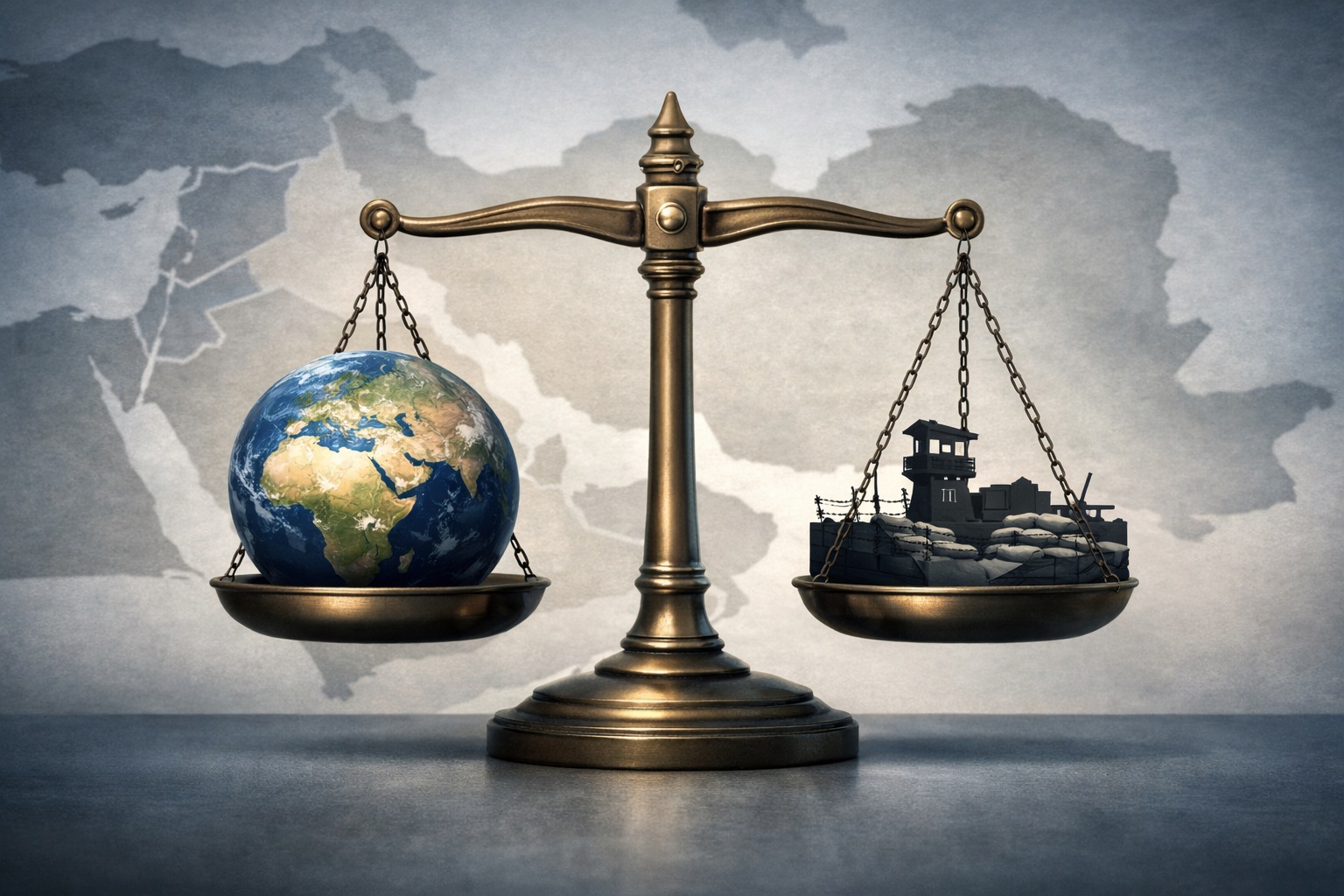
Rising tensions in the Middle East have reignited a crucial legal question: when does international law actually allow a state to use military force?
Recent military strikes involving Iran, Israel and the United States have once again placed international law at the center of the global debate.
Beyond geopolitics and military strategy, the key issue is legal: under what conditions can a country legitimately invoke self-defense to justify the use of force?
The answer depends largely on how the United Nations Charter, the cornerstone of modern international law, regulates armed conflict between states.
The fundamental rule: the prohibition on the use of force
One of the central principles of the international legal system is that states are generally prohibited from using military force against other states.
This rule is set out in Article 2(4) of the United Nations Charter, which requires countries to refrain from the threat or use of force against the territorial integrity or political independence of another state.
Adopted after World War II, the provision was designed to prevent unilateral military aggression and preserve international peace.
There are only two widely recognized exceptions to this rule:
- authorization by the United Nations Security Council,
- the right of self-defense.
Without one of these legal bases, the use of military force is usually considered unlawful under international law.
Article 51 and the right of self-defense
The legal framework for self-defense is defined in Article 51 of the UN Charter.
This provision recognizes the “inherent right of individual or collective self-defense” if a member state becomes the victim of an armed attack.
In other words, international law allows a state to respond militarily if it has been attacked.
However, this right is not unlimited. Legal doctrine and international jurisprudence have developed two essential conditions.
Necessity
The use of force must be necessary because no peaceful alternative is available.
Proportionality
The response must be proportionate and limited to what is required to repel the attack.
These two criteria are widely considered essential to determine whether a military operation qualifies as lawful self-defense.
The controversial doctrine of pre-emptive self-defense
One of the most debated questions in international law concerns the idea of pre-emptive or preventive self-defense.
Some states argue that they should be allowed to use force before an attack actually takes place, especially if the threat appears imminent.
Supporters claim that modern warfare — including long-range missiles and potential nuclear capabilities — makes waiting for an actual attack strategically unrealistic.
Critics, however, warn that expanding the definition of self-defense could weaken one of the core principles of international law: the prohibition on the use of force.
For this reason, preventive military strikes remain one of the most controversial issues in contemporary legal doctrine.
The key legal question in the case of Iran
When assessing a strike against Iran, the legal question becomes whether the strict conditions for self-defense are truly satisfied.
Under international law, a state seeking to justify military action would need to demonstrate that:
- an armed attack has occurred, or
- an attack is imminent and unavoidable,
- and that the military response is necessary and proportionate.
If these conditions cannot be clearly established, the action could potentially be classified as an unlawful use of force under international law.
A debate that goes beyond the Middle East
The discussion surrounding strikes on Iran extends far beyond regional geopolitics.
At stake is the broader credibility of the international legal order that governs the use of force between states.
If the concept of self-defense is interpreted too broadly, the prohibition on the use of force — one of the pillars of the UN Charter — risks gradually losing its effectiveness.
For this reason, the legal interpretation of these events will likely remain a subject of intense debate among governments, international institutions and scholars of international law.
Author
Matteo della Pietra
Italian lawyer and legal commentator.