
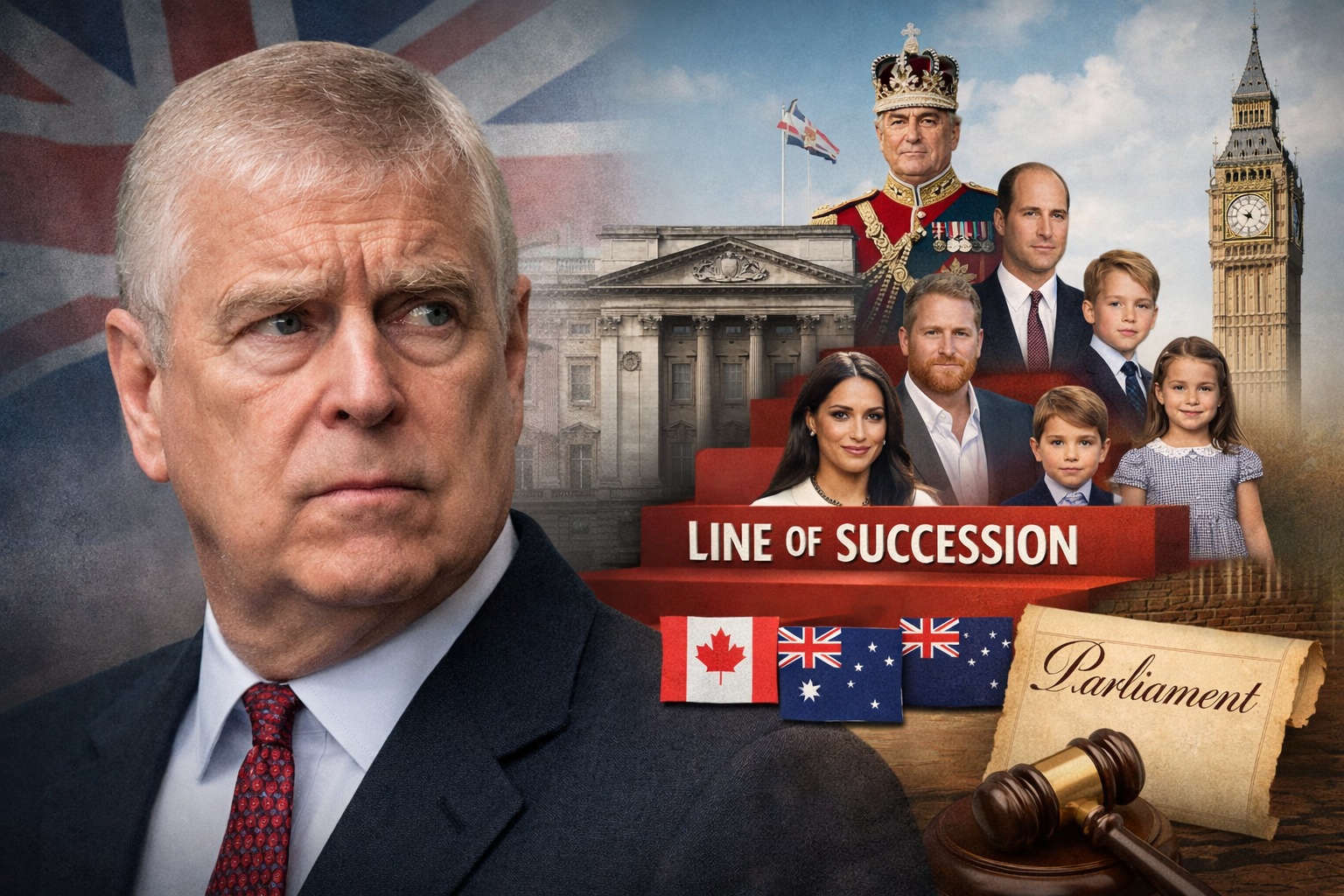
Recent debates in the UK have raised a key question: can a member of the royal family be legally excluded from the line of succession?
After stepping back from public duties and losing official roles, Prince Andrew’s position in the line of succession has come under renewed scrutiny.
The central question is not simply political: it touches the core of British constitutional law and the rules that govern the monarchy.
The basics: who controls the line of succession?
In the United Kingdom, the monarchy is regulated by law, not by personal discretion.
This means the Sovereign cannot remove a person from the line of succession on their own.
Any changes to the order of succession can only be made by Parliament, under legislation such as the Succession to the Crown Act 2013.
Currently, there is no law or parliamentary initiative to remove Prince Andrew.
Why changing the succession is complicated
Technically, Parliament has the power to modify succession laws.
In practice, such a change is delicate because it affects:
- the stability of the monarchy,
- the constitutional balance,
- relationships with other Commonwealth countries that share the same Sovereign.
A unilateral change could have legal and diplomatic consequences outside the UK.
The role of the Commonwealth
The British monarch is also the head of state of several Commonwealth countries, including Canada, Australia, and New Zealand.
Any modification to succession must be coordinated with these countries to maintain legitimacy and consistency.
The 2013 reforms demonstrate this principle: changes were discussed and agreed across the Commonwealth to avoid legal misalignments.
Removing Prince Andrew unilaterally could create serious legal and diplomatic issues.
Historical precedent
The most famous precedent is the abdication of Edward VIII in 1936.
However, that was a voluntary abdication, later formalized by Parliament.
Andrew’s potential exclusion is different: it involves removing a family member from the hereditary order, not abdication.
Key constitutional principles
The UK monarchy relies on three pillars:
- political neutrality,
- continuity,
- dynastic stability.
Changing the line of succession for reputational or political reasons would be highly sensitive.
What could realistically happen now
1️⃣ No legislative change: Andrew remains in the line but without public role.
2️⃣ Specific legislation: Parliament passes a law excluding him.
3️⃣ Broader succession reform: a wider update of succession rules.
Currently, no concrete parliamentary action is underway.
Conclusion
Legally, Parliament could remove Prince Andrew from the line of succession, but constitutionally, the issue is complex and politically sensitive.
It is not a decision for the Sovereign alone. Any action would need careful consideration of the monarchy’s stability and Commonwealth relations.
Author
Matteo della Pietra
Italian lawyer and legal commentator on constitutional law.